Showing posts with label asia. Show all posts
Showing posts with label asia. Show all posts
Saturday, September 20, 2008

Sunday, September 7, 2008
Friday, September 5, 2008
Thursday, September 4, 2008
Wednesday, September 3, 2008
Wednesday, August 20, 2008
31 - Nvadwip, India

Upstream from Calcutta.
Nabadwip (নবদ্বীপ) (also Navadwip, Navadvipa or Nabadwipdham) is a city and a municipality in Nadia district in the Indian state of West Bengal. Its name means "9 islands" in the Bengali language. The islands are named Antardwip (Sri Mayapur), Simantadwip, Rudradwip, Madhyadwip, Godrumdwip, Ritudwip, Jahnudwip, Modadrumdwip, and Koladwip. It is a place of many lilas (or "pastimes of God" in Hinduism) of Sri Caitanya Mahaprabhu. Many pilgrims from origins worldwide adhering to Gaudiya Vaishnavism come to Navadwip every year on pilgrimage and for festivals like Sri Navadvipa-mandala Parikrama and holidays like Gaura Purnima.
Monday, August 18, 2008
Thursday, August 14, 2008
Wednesday, August 13, 2008
Thursday, July 24, 2008
Wednesday, July 23, 2008
23 - Feng-huang, China
County in W Hunan province.
Fenghuang are mythological Chinese birds that reign over all other birds. The males are called Feng and the females Huang. In modern times, however, such a distinction of gender is often no longer made and the Feng and Huang are blurred into a single feminine entity so that the bird can be paired with the Chinese dragon, which has male connotations. The Fenghuang is also called the "August Rooster" (traditional Chinese: 鶤雞; pinyin: kūnjī) since it sometimes takes the place of the Rooster in the Chinese Zodiac. In the West, it is commonly referred to as the Chinese phoenix.
Tuesday, July 22, 2008
Monday, July 21, 2008
Sunday, July 20, 2008
20 - Chofu, Japan
Outer district of Tokyo, on the bank of Tama-gawa.
Chōfu (調布) is a western suburb of Tokyo, and the main draws are Jindaiji Temple and Jindai Botanical gardens. These twin attractions are next to each other, making a reasonable day trip from central Tokyo. Beyond these two, Chōfu feels like the suburb that it is, particularly on the the weekends when the train platform is crowded with parents and their children.
Saturday, July 19, 2008
19 - Bicoli, Halmahera, Indonesia
On the E peninsula of the big island W of New Guinea. Here's a butterfly native to the island:

Thursday, July 17, 2008
17 - Zamboanga, Philippines
On the tip of Mindanao's western peninsula.
Zamboanga City brings its best foot forward during the popular Fiesta Pilar, celebrated in honor of the city's patron saint, La Nuestra Senora del Pilar de Zaragoza Our Lady of the Pillar of Zaragoza, Spain. A statue honoring the saint is prominently embossed above the façade on the eastern wall of the meter-thick walled fort called El Real Fuerza de Nuestra Señora del Pilar de Zaragoza (also called El Real Fuerza de San José in its early days). This Spanish military fort was built on June 23, 1635, by the Spanish Jesuit priest Fr. Melchor de Vera in defense against pirates and slave raiders. Zamboanga City is one of the oldest cities in the country and is the most Hispanized. It is also one of the largest cities in the world in terms of area, with over 1,480 km², including its 28 surrounding islands. Its recorded population in 2007 was 774,407.
Wednesday, July 16, 2008
Monday, April 21, 2008
44 - Qias, Iran
In the upper NW tip of the country, 20mi. from the Armenian border. Nothing to do with the site, but a "qias" image search turned out that particular string of letters in the Amazon.com url for this:


Friday, April 18, 2008
Wednesday, April 16, 2008
40 - Mogocha, Russia
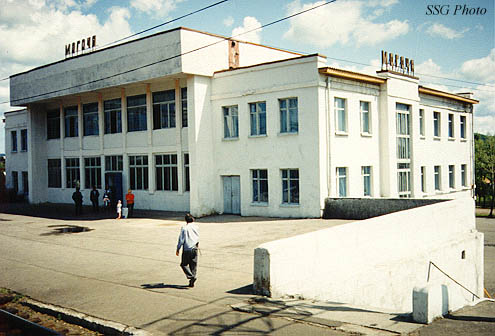
On the trans-Siberian railway, about 450mi E of Lake Baikal. Here's Wikipedia's history of the town. The last sweeping sentence is intriguing.
Name 'Mogocha' has at least two meanings in Evenk language: a. mongo - Evenk tribename and possessive suffix chi; b. "mongochi" means "golden valley". Local expression: "God created Sochi, and Satan Mogocha"
Mogocha was founded in 1910 and granted town status in 1950. Most of its population came from European part of the USSR to work for Trans-Siberian Railway company and in gold mines since the 1930s.
One third of Mogocha's population fled to nearby cities. This tendency is a Siberiawide practice because of notorious economic crisis of the 90s. At the same time a significant number of Chinese citizens and companies try to sing their roots in the region.
Photo from Transsib.ru.
Subscribe to:
Posts (Atom)