
Tuesday, April 22, 2008
45 - Ryl'sk, Russia
60mi. W of Kursk, 160mi E of Kiev. A merchant from Ryl'sk, Grigory Shelikhov, founded the first Russian settlements in North America. The town has quite a coat-of-arms:


Monday, April 21, 2008
44 - Qias, Iran
In the upper NW tip of the country, 20mi. from the Armenian border. Nothing to do with the site, but a "qias" image search turned out that particular string of letters in the Amazon.com url for this:


Saturday, April 19, 2008
Friday, April 18, 2008
Thursday, April 17, 2008
41 - Novaya Zemlya, Russia
Big icecapped island N of Russia. In fact, it's the northernmost bit of the Urals. Atomicforum.com adds this:


The first nuclear test fired at Novaya Zemlya was an underwater test on September 21, 1955. It was a test of the RDS-9 warhead deployed on the 53-58 (T-5) torpedo. Over 30 ships were positioned around the explosion at distances ranging from 984 feet to 5249 feet. Among the ships were four destroyers, three submarines, minesweepers and seaplanes. Over 500 goats and sheep, 100 dogs, and other animals were on board the ships. Only one ship was sunk by the explosion, a destroyer less than 984 feet from the explosion.
Wednesday, April 16, 2008
40 - Mogocha, Russia
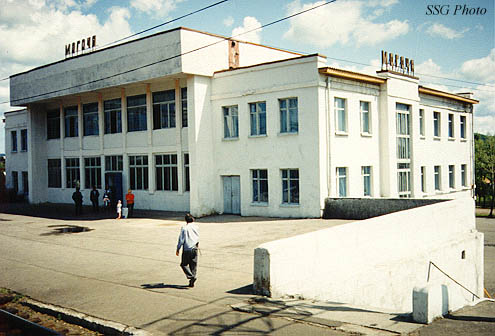
On the trans-Siberian railway, about 450mi E of Lake Baikal. Here's Wikipedia's history of the town. The last sweeping sentence is intriguing.
Name 'Mogocha' has at least two meanings in Evenk language: a. mongo - Evenk tribename and possessive suffix chi; b. "mongochi" means "golden valley". Local expression: "God created Sochi, and Satan Mogocha"
Mogocha was founded in 1910 and granted town status in 1950. Most of its population came from European part of the USSR to work for Trans-Siberian Railway company and in gold mines since the 1930s.
One third of Mogocha's population fled to nearby cities. This tendency is a Siberiawide practice because of notorious economic crisis of the 90s. At the same time a significant number of Chinese citizens and companies try to sing their roots in the region.
Photo from Transsib.ru.
Tuesday, April 15, 2008
39 - Loshkalakh, Russia
NW of Magadan, in far eastern Siberia. Here's a hitchhiking video from the region:
Saturday, April 12, 2008
Friday, April 11, 2008
Thursday, April 10, 2008
Wednesday, April 9, 2008
35 - Hadera, Israel
Halfway between Haifa and Tel Aviv. Wiki:
Hadera was founded in 1891, at the dawn of modern Zionism by Eastern European immigrants who were members of the Zionist group Hovevei Zion on land purchased by Yehoshua Hankin, who was known as the Redeemer of the Valley. The land was purchased from Christian effendi Selim Khuri. The purchase of the land was the largest so far in Palestine by Zionist groups, although was of low quality, with most of it being swampland. Before its purchase, the land had hardly any residents apart from a few families belonging to small tribes who were mainly shepherds raising water buffaloes and selling reeds. The town derives its name from the Arabic word khadra, meaning "green" in reference to the wild weeds which covered the marshes on which the town is built.[1] The initial settlers lived in a house known as the Khan which is next to the main synagogue of the city.
Tuesday, April 8, 2008
Monday, April 7, 2008
33 - Farasan Islands, Saudi Arabia
In the Red Sea, just N of the Yemeni border.
Wikipedia:
This site:
Wikipedia:
The Arabian gazelle (Gazella arabica) was an elusive gazelle that was hunted to extinction in its Middle Eastern homeland, Saudi Arabia. It is only known from a single specimen collected on the Farasan Islands in the Red Sea in 1825. Since the 1996 IUCN Red List of Threatened Species this species is included as extinct by its Antelope Specialist Group.
This site:
Throughout western and southern Arabia, these variable gazelles were once common and widespread. Today the total global population is estimated to be no higher than 20 000.
Sunday, April 6, 2008

Saturday, April 5, 2008
31 - Dajal, Pakistan
At the Western slope of the Indus plain. Home to the eponymous cattle sub-breed:


Friday, April 4, 2008
Thursday, April 3, 2008
29 - Babai, Madhya Pradesh, India
50mi. SE of Bhopal, on the Narnada River. Or south of the Naranda River (at least the two MP Babais on Google Maps are).
Wednesday, April 2, 2008
28 - Agartala, Tripura, India
Right on the E border with Bangladesh. They have a famous Durga Puja there ... or at least, most of the videos one finds about Agartala have to do with the Durga Puja. In this case: with snakes!
Tuesday, April 1, 2008
27 - Zanzibar, Tanzania
View Larger Map
The Z's right in the courtyard of the House of Wonders (Beit al-Ajab), so-called because of its early use of exterior lighting (the better for the Sultan to impress his Sultanate). Now it houses a museum, which, alas, I wasn't able to visit a few years back in '99 — if it'd even existed then. The park between the House of Wonders and the waterfront is home to all manner of tasty seaside vended-food, come nightfall.
Monday, March 31, 2008

Sunday, March 30, 2008
25 - Xieng Khoang, Laos
City in the center of the North. Also the province that's home to the famous Plain of Jars. Here's some Lao Karaoke on the subject:
P.S. Second day in a row on Plate 25 — Xs don't appear on every atlas page so I had to go for what was near.
P.S. Second day in a row on Plate 25 — Xs don't appear on every atlas page so I had to go for what was near.
Saturday, March 29, 2008
25 - Wiang Pa Pao, Thailand
60mi. NE of Chiang Mai. In Thai script, that's เวียงป่าเป้า. Here's what it looks like to ride a motorcycle in the area:
Friday, March 28, 2008
Thursday, March 27, 2008
23 - Urn Island, Hong Kong
Not a lot of U's in SE China, at least in the pinyin system used in my Times Atlas. Urn Island is in the NE part of the Hong Kong territories. Seems to be the island now known as Tai Tau Chau (大頭洲). Here's some footage that may be of 大頭洲, or if not that, shot from 大頭洲 looking elsewhere.
Wednesday, March 26, 2008
Tuesday, March 25, 2008
21 - Sangju, South Korea
Small town pretty much at the center of the country. Wikipedia:
Here's a sculpture by Dong-Heon Kim, carved in "marble, sangju stone":

The economy of Sangju is traditionally agricultural. Agriculture remains an important sector, as 40% of the city's residents are engaged in farming. Sangju has the largest number of farming households of any district in South Korea, and the most agricultural land of any district in North Gyeongsang.
The area has been famed for sericulture (silk production) since Silla times. Currently 243,000 m² of land are engaged in silk production, bringing in about 434 million won annually. In addition, numerous other cash crops are farmed in the area. The most important agricultural product is rice, in the production of which Sangju is 7th in the country, with 169.13 km² in production yielding 162.9 billion won. Other important products include grapes, apples, pears, and cucumbers.
Here's a sculpture by Dong-Heon Kim, carved in "marble, sangju stone":

Subscribe to:
Posts (Atom)